Blog
Business Electricity Providers: Who Sells Commercial Power in 2026, Compared

Updated on October 1, 2026
12 min read
Last updated September 28, 2026 · Every provider detail below was read from that provider’s own business pages on that date. Where a provider publishes no price, we say so.
Business electricity providers are the retail suppliers licensed to sell the energy portion of a commercial bill in the 14 U.S. markets with retail choice: Texas, Ohio, Pennsylvania, Illinois, New Jersey, New York, Maryland, Delaware, Massachusetts, Connecticut, Rhode Island, New Hampshire, Maine and the District of Columbia. As of September 28, 2026 the ones that matter to a small or mid-sized business are Constellation, NRG Business and its Reliant and Direct Energy brands, TXU Energy, Champion Energy, Gexa Energy and APG&E.
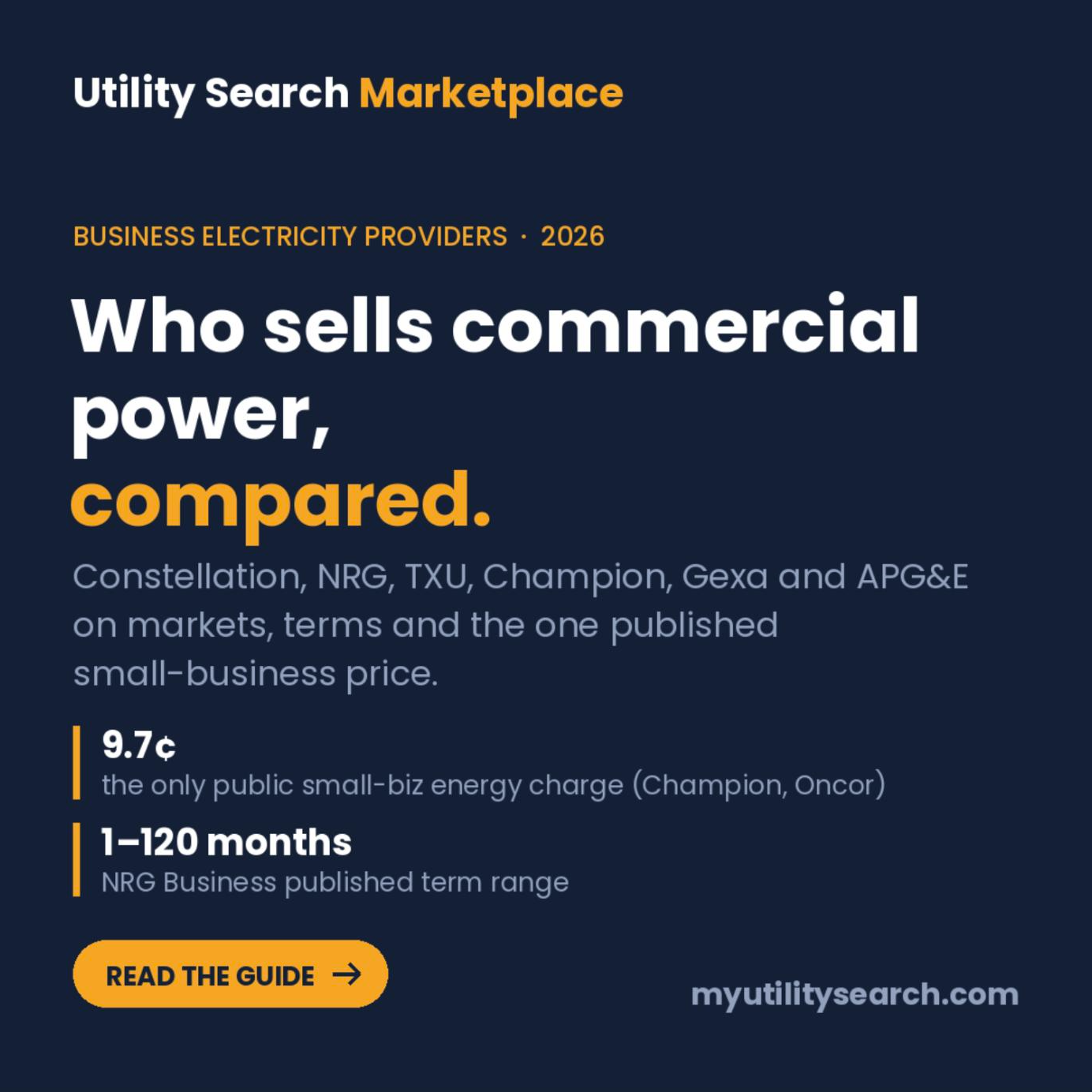
Only one of them, Champion, publishes a small-commercial price you can read without a quote: 9.7¢ per kWh on an 18-month Oncor plan. The rest price off your meter and usage history, which is why this page compares them on the four things that actually differ — reliability, cost savings, plan flexibility and ease of doing business — rather than on a rate card none of them publish.
Best for most small businesses: a fixed-rate term from a provider that serves your utility territory, quoted on your own interval data rather than a published rate card. Business rates are not listed publicly the way residential rates are, so the only real number is the quote for your meter. Start with your utility territory and your annual kilowatt-hours before comparing providers.
TL;DR — picking among business electricity providers
- Widest footprint among business electricity providers: Constellation (electricity in 10 choice markets) and APG&E (7). Everyone else on this list is Texas-only or Texas-plus-Northeast.
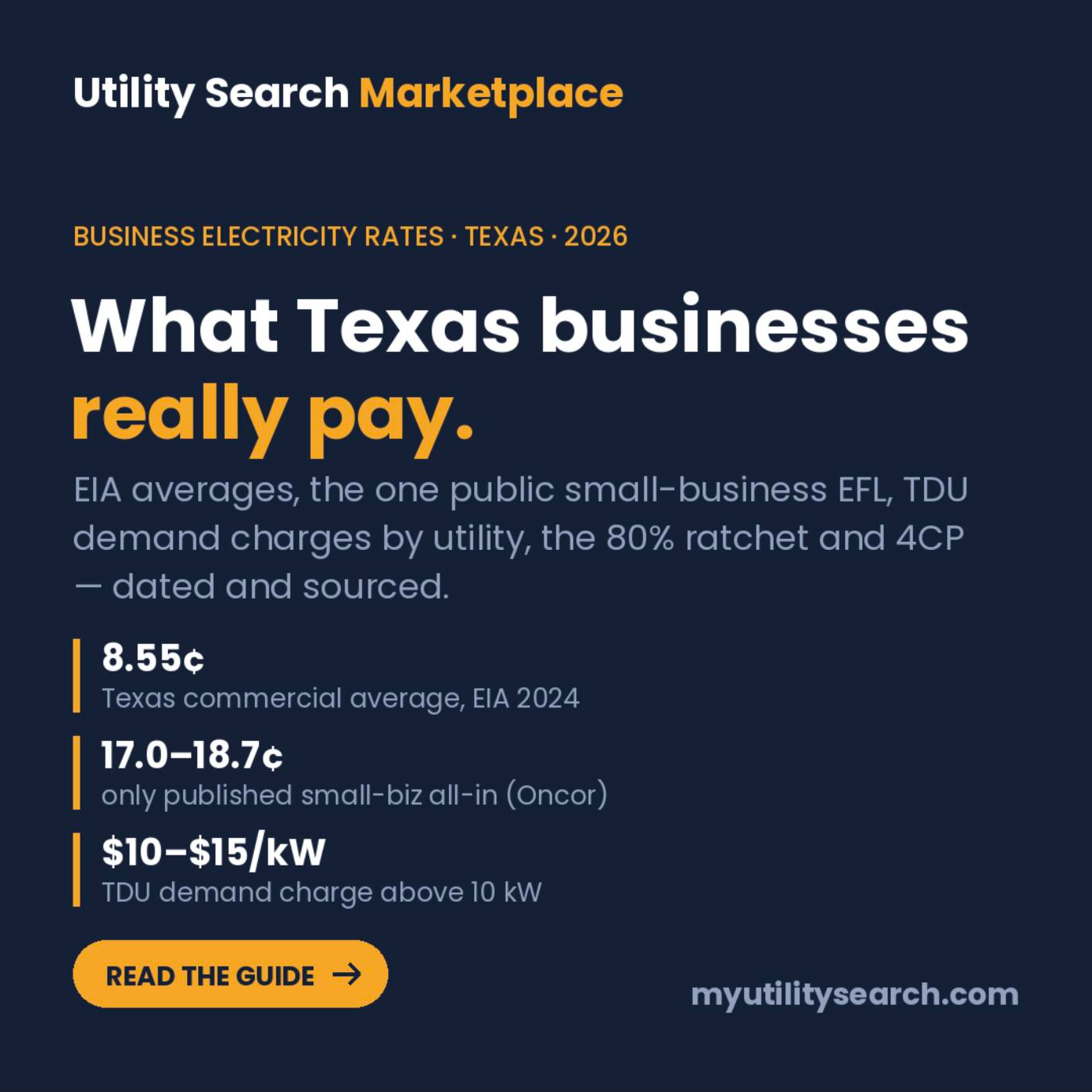
- Only published small-business price: Champion Energy, Business Savings Champ 18 — 9.7¢ energy charge, 17.0–18.7¢ all-in on Oncor, EFL dated September 28, 2026.
- Longest published term range: NRG Business, 1 to 120 months.
- Clearest exit terms: NRG Business Texas: $250 per remaining month, capped at 12 months. Most providers keep the fee in the contract, not on the site.
- Satisfaction guarantees: TXU Energy (60 days) and APG&E (60 days). No other business electricity providers publish one.
- What none of them change: delivery. Your utility still owns the wires and the delivery charge; these providers only replace the supply line.
The business electricity providers that matter in 2026
This table is built from each provider’s business pages as read on September 28, 2026. “Quote only” means the provider publishes no commercial price online and prices each account individually.
| Provider | Parent | Business electricity markets | Small-business pricing | What it publishes |
|---|---|---|---|---|
| Constellation | Constellation Energy | TX, IL, OH, PA, NJ, MD, DC, MA, CT, DE (gas also in IL, OH, PA, NJ, MD, DC, GA, VA, KY, MI, IN) | Fully bundled fixed plans viewable and signable online by location; capacity-adjust and custom plans by phone | Three plan structures (fully bundled fixed, capacity adjust, custom); state-by-state availability table |
| NRG Business | NRG Energy | Texas (REP #10011); commercial and industrial nationally through NRG | Quote only; “terms from 1 to 120 months” | Texas small-commercial terms of service: Smart Lock Business Plan, $4.95 base charge per meter, TDSP charges passed through without markup, early-termination fee $250 × remaining months (max 12) |
| Direct Energy Business | NRG Energy | Texas, Northeast, Midwest (gas in Northeast and Midwest) | Online portal by service location or custom quote | Small business defined as “10,000 square feet or less”; no meter changes, no service interruption on switch |
| Reliant Business | NRG Energy | Texas | Custom quote by ZIP | 24/7 support, online usage tracking; plan detail behind the quote form |
| TXU Energy Business | Vistra | Texas | Custom quote; small-business specialists Mon–Sat | 60-day Total Satisfaction Guarantee; Business Surge Protect add-on $10.95–$24.95 a month |
| Champion Energy | Calpine | Texas small commercial; multi-state C&I | Published EFL: Business Savings Champ 18 — 9.7¢/kWh energy charge on Oncor | Average price 18.7¢ at 1,500 kWh, 17.5¢ at 2,500, 17.0¢ at 3,500; 18 months; 20% renewable; PUC #10098; EFL dated 9/28/2026 |
| Gexa Energy Business | NextEra Energy | Texas | Quote; Fixed Price product with “price certainty and term flexibility” | Product name only; no terms or prices online |
| APG&E | Independent (since 2004) | TX, MD, NJ, NY, OH, PA, IL | Quote by phone or form | 60-Day Satisfaction Guarantee; broker channel program; MyAccount portal |
Sources: each provider’s business plans, state availability or terms-of-service page, read September 28, 2026. Full list in Sources below.
How to judge business electricity providers: the four tests
Copilot, ChatGPT and the broker on the phone all end up asking the same four questions about business electricity providers. Here is what each one means and what to look for.
1. Reliability
Reliability of supply is not something a retail provider controls — the wires, the outages and the restoration belong to the utility in every choice market. What you are judging is the reliability of the company, and business electricity providers differ here mainly in licensing and backing: whether it is licensed (Texas providers carry a PUCT REP certificate; Champion is #10098, NRG Business is #10011), whether it is backed by a generator or a large parent (Constellation, NRG, Vistra, Calpine and NextEra all are), and whether its contract passes delivery charges through at cost. NRG Business is the one provider on this list that states the pass-through in writing on its terms page.
2. Cost savings
The only honest way to measure savings is against your utility’s default rate for the same period and the same load. Because most business electricity providers quote rather than publish, get every quote as an all-in price per kWh at your actual monthly usage, on the same term, and compare it to the default. Champion’s EFL shows why usage matters: the same 9.7¢ energy charge produces an 18.7¢ all-in price at 1,500 kWh and 17.0¢ at 3,500 kWh once delivery is included.
3. Plan flexibility
Flexibility means term length, product type and exit terms. NRG Business publishes the widest term range (1 to 120 months); Constellation publishes three structures (fully bundled fixed, capacity-adjust, custom); the other business electricity providers offer fixed-price plans on request. The exit term is the one to read twice: NRG’s Texas fee is $250 for each remaining month up to 12, so a 36-month contract cancelled in month 6 costs $3,000, not $7,500.
4. Ease of doing business
Can a small business sign up online, or does every plan start with a sales call? Constellation lets you view and sign fully bundled fixed plans online by location. Direct Energy runs an online portal by service location. TXU, Reliant, Gexa, APG&E and NRG Business route small accounts to a quote form or a specialist. Two business electricity providers stand behind the sign-up with a guarantee: TXU Energy’s 60-day Total Satisfaction Guarantee and APG&E’s 60-Day Satisfaction Guarantee.
Compare business electricity at your address
Commercial contracts are priced off your meter and 12 months of usage, not a published rate card. Start with what your address can actually buy.
Pros and cons of each of the business electricity providers
These are drawn from what each provider publishes, not from reviews. A blank on a provider’s own site is itself a finding.
Constellation
Pros: the widest electricity footprint of any of the business electricity providers here (10 choice markets including D.C.), fully bundled fixed plans that a small business can price and sign online, and a published state-by-state availability table. Cons: the capacity-adjust structure moves part of your cost with auction results, and custom plans require a call.
NRG Business (with Reliant and Direct Energy)
Pros: the only provider that publishes its Texas small-commercial terms in full — a $4.95 base charge per meter, delivery passed through without markup, and a capped early-termination fee — plus terms from 1 to 120 months and three consumer-facing brands (Reliant, Direct Energy, Green Mountain) under one parent. Cons: no published price; the small-business page needs a quote, and the Texas terms document on the site is dated May 2022.
TXU Energy
Pros: a 60-day Total Satisfaction Guarantee, small-business specialists six days a week, and the Business Surge Protect add-on for equipment. Cons: Texas only; no plan names, terms or prices published for business accounts.
Champion Energy
Pros: the one small-commercial Electricity Facts Label you can read today — 9.7¢ energy charge, 18 months, 20% renewable, PUC #10098 — which makes it the benchmark every other quote should beat. Cons: the early-termination fee is calculated from your annual usage rather than stated as a number, and the published plan is Oncor-only.
Gexa Energy
Pros: NextEra parent, a named Fixed Price small-business product. Cons: Texas only and nothing beyond the product name is published.
APG&E
Pros: seven choice markets, a 60-day satisfaction guarantee, an independent operator since 2004 and an established broker channel. Cons: no online pricing; business-hours support only.
What business electricity costs where business electricity providers compete
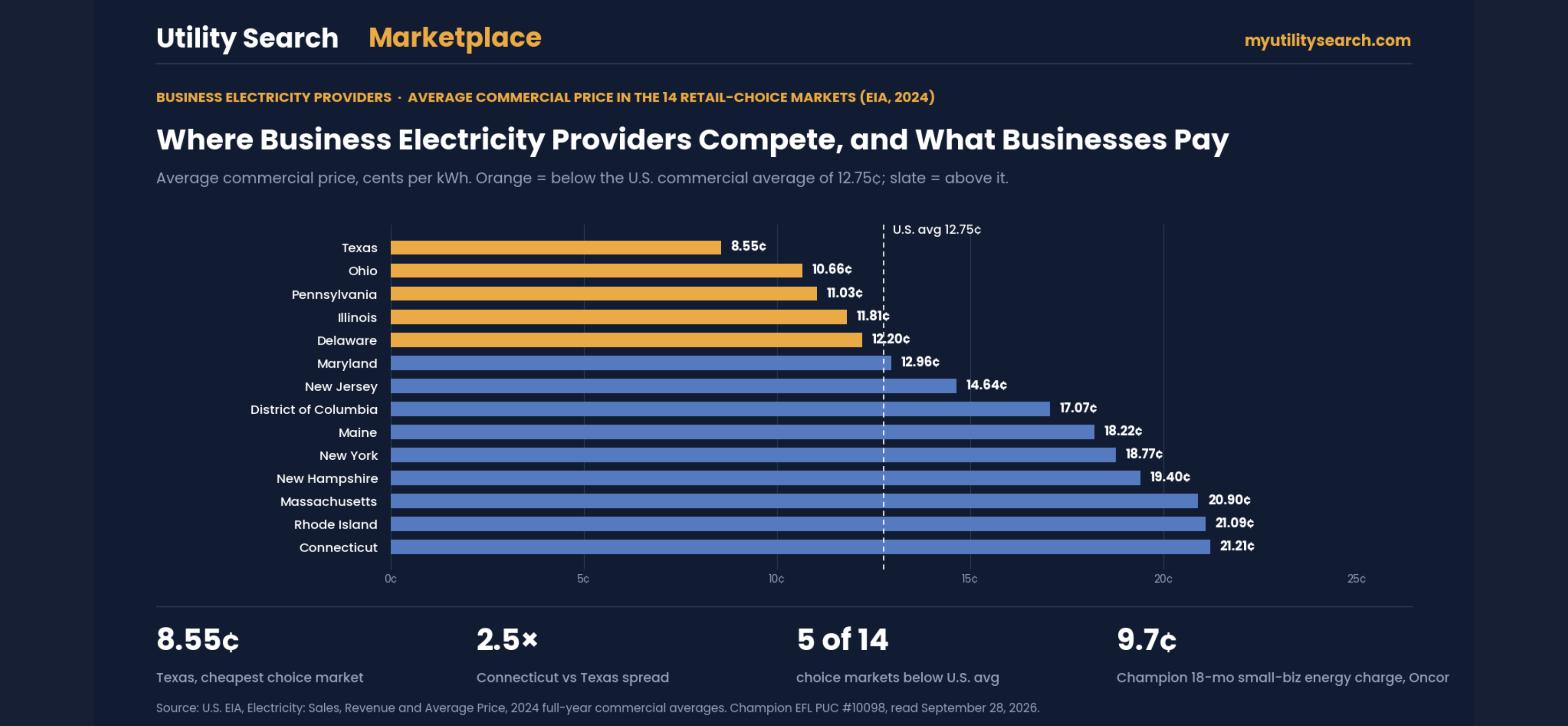
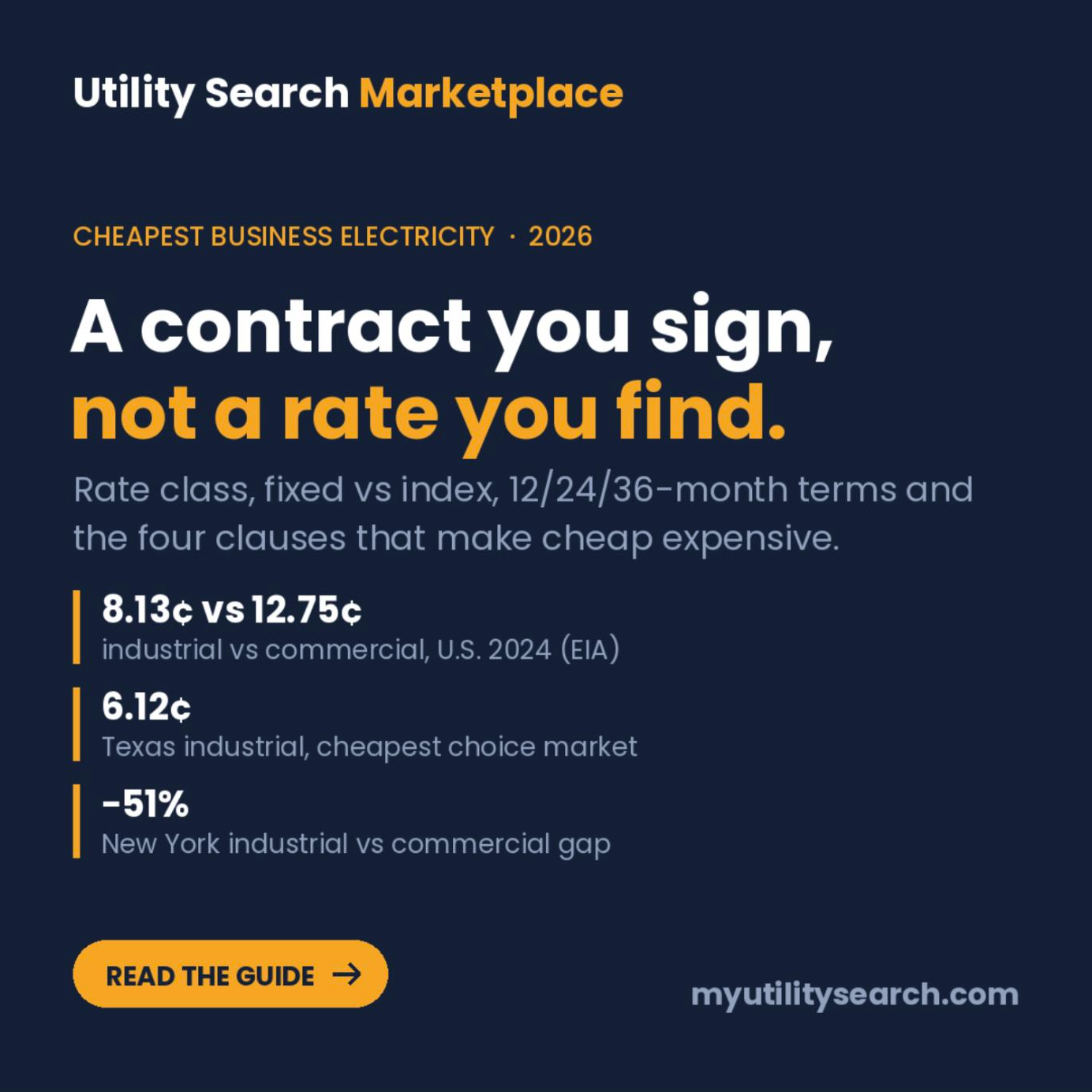
The average commercial price in the 14 choice markets runs from 8.55¢ per kWh in Texas to 21.21¢ in Connecticut, a 2.5× spread, against a U.S. commercial average of 12.75¢ (EIA, 2024 full-year data). Five choice markets sit below the national average — Texas, Ohio, Pennsylvania, Illinois and Delaware — and the nine Northeastern markets sit above it. The spread matters because it sets the ceiling on what any provider can save you: a supplier competing against a 21¢ default in Connecticut has far more room than one competing against 8.55¢ in Texas.
| Choice market | Avg commercial price (EIA 2024) | vs U.S. 12.75¢ | Providers on this page that serve it |
|---|---|---|---|
| Texas | 8.55¢ | −4.20¢ | All eight |
| Ohio | 10.66¢ | −2.09¢ | Constellation, APG&E |
| Pennsylvania | 11.03¢ | −1.72¢ | Constellation, APG&E, Direct Energy |
| Illinois | 11.81¢ | −0.94¢ | Constellation, APG&E, Direct Energy |
| Delaware | 12.20¢ | −0.55¢ | Constellation |
| Maryland | 12.96¢ | +0.21¢ | Constellation, APG&E, Direct Energy |
| New Jersey | 14.64¢ | +1.89¢ | Constellation, APG&E, Direct Energy |
| District of Columbia | 17.07¢ | +4.32¢ | Constellation |
| New York | 18.77¢ | +6.02¢ | APG&E, Direct Energy |
| Massachusetts | 20.90¢ | +8.15¢ | Constellation |
| Connecticut | 21.21¢ | +8.46¢ | Constellation |
Maine (18.22¢), New Hampshire (19.40¢) and Rhode Island (21.09¢) also have retail choice, but none of the eight providers above list them as a small-business market. Direct Energy’s “Northeast and Midwest” coverage is listed by service location on its site; confirm your utility there before assuming availability.
Business electricity providers in Texas: reading the one EFL that is public
Texas is the only choice market where a small business can compare business electricity providers on a standardized document, the Electricity Facts Label, and Champion’s is the only small-commercial EFL on this page that is public without a quote. Read on September 28, 2026 for the Oncor delivery area: a fixed energy charge of 9.7¢ per kWh, an 18-month term, 20% renewable content, and an average all-in price of 18.7¢ at 1,500 kWh, 17.5¢ at 2,500 kWh and 17.0¢ at 3,500 kWh a month. The gap between the 9.7¢ energy charge and the 17–19¢ average is Oncor’s delivery charge and the plan’s base charge, which no provider can remove.
That is the number to hold every Texas quote against. If TXU, Reliant, Gexa or NRG Business quote you an all-in price, ask for it at your real monthly usage on the same term and compare it to 17.0–18.7¢ for the same load. Then check what Power to Choose does and does not show a business — our Power to Choose comparison covers it — and see the Texas electricity hub for the residential side of the same providers.
Broker or direct?
Every provider on this page also sells through brokers, and two (NRG Business and APG&E) publish a broker channel program. A broker prices your meter against several business electricity providers at once and is paid by the winning supplier, which is why a broker quote and a direct quote for the same contract can differ by the broker’s margin in either direction. For a single small meter, going direct to Champion or Constellation is fast and transparent. For multiple sites, demand over roughly 50 kW, or any contract longer than 24 months, a broker’s comparison across business electricity providers usually pays for itself. Our business electricity guide walks through both paths.
Frequently asked questions about business electricity providers
Who are the largest business electricity providers?
By footprint, Constellation (10 retail-choice electricity markets including D.C.) and NRG Energy through NRG Business, Reliant and Direct Energy. In Texas, the largest by brand are TXU Energy, Reliant, Direct Energy, Gexa and Champion; APG&E is the largest independent serving seven choice markets.
Can a small business sign up for a plan online?
With Constellation, yes — fully bundled fixed plans can be viewed and signed online by location. Direct Energy runs an online portal by service location. TXU Energy, Reliant, Gexa, NRG Business and APG&E start with a quote form or a call as of September 28, 2026.
Do business electricity providers publish their rates?
Almost never. Of the eight providers compared here, only Champion Energy publishes a small-commercial Electricity Facts Label without a quote: 9.7¢ per kWh on an 18-month Oncor plan. The others price each account off its meter and 12 months of usage.
What is a normal contract length for a business electricity plan?
12 to 36 months is typical; NRG Business publishes terms from 1 to 120 months and Champion’s public plan is 18 months. Longer terms buy price certainty at the cost of a larger early-termination exposure, so read the exit clause before choosing the term.
Will switching business electricity providers interrupt service?
No. The utility keeps delivering power and handling outages; only the supply line on the bill changes. Direct Energy states it directly: no physical modifications to your facility or meter, and no loss of service on the switch.
Is comparing business electricity providers here free?
Yes. Comparing and connecting through this site is free, and the price you pay is the provider’s own price.
How do I find the electricity provider for my business address?
Start with the delivery utility, which is fixed by your address, then shop suppliers licensed in that territory. Your most recent bill names both. Business quotes depend on your meter’s usage pattern, so a provider that is cheapest for one business on a street can be more expensive for the one next door.
Is business electricity cheaper than residential?
Often per kilowatt-hour, yes, because business rates are quoted against your actual usage profile and can include demand charges that residential bills do not have. A steady, predictable load gets the best pricing. A business with sharp peaks can pay more per kilowatt-hour than a home on the same street.
Bottom line on business electricity providers
Treat the eight business electricity providers above as two groups. Constellation and APG&E are the multi-state options, and the only two that a business outside Texas can compare head to head on the same footprint. In Texas, hold every quote from TXU, Reliant, Direct Energy, Gexa and NRG Business against Champion’s published 9.7¢ energy charge and 17.0–18.7¢ all-in price for the same usage and term, then read the exit clause before you read the rate. The provider that publishes its terms is the one you can actually compare; among business electricity providers, that transparency is the first of the four tests, not the last.
Compare business electricity at your address
Commercial contracts are priced off your meter and 12 months of usage, not a published rate card. Start with what your address can actually buy.
Sources
- Constellation — Electricity Options for Small Businesses and Energy Solutions by State
- NRG Energy — Commercial Energy Plans and NRG Business Texas small commercial terms of service (REP #10011)
- Direct Energy — Small Business
- Reliant Energy — Small Business Plans
- TXU Energy — Small Business Electricity
- Champion Energy — Business Savings Champ 18 Electricity Facts Label (PUC #10098)
- Gexa Energy — Small Business Product Offerings
- APG&E — Small Business Electric Service
- U.S. Energy Information Administration — Electricity: Sales, Revenue and Average Price, 2024
Keep going
- Business electricity rates Texas — EIA averages, the one public small-business EFL, TDU demand charges by utility and 4CP
- Business electricity: how commercial power is bought, and how to buy it well
- Commercial electricity rates by state, cheapest to most expensive
- Texas electricity: the deregulated-market hub
- Ohio Apples to Apples: Price to Compare by utility
- PA Power Switch: Pennsylvania Price to Compare by utility
- ComEd rate increase: what Illinois businesses should do
- Business internet providers compared
- Cheapest business electricity: contracts, terms and what each business type pays
- Business utilities hub: every utility a new location needs, and what each costs